
We do not claim what we cannot measure
If we commit to a tolerance, we have a method that measures it and a record of it. We do not commit to what we cannot measure.
WHO WE AREKılıçaslan Aluminium
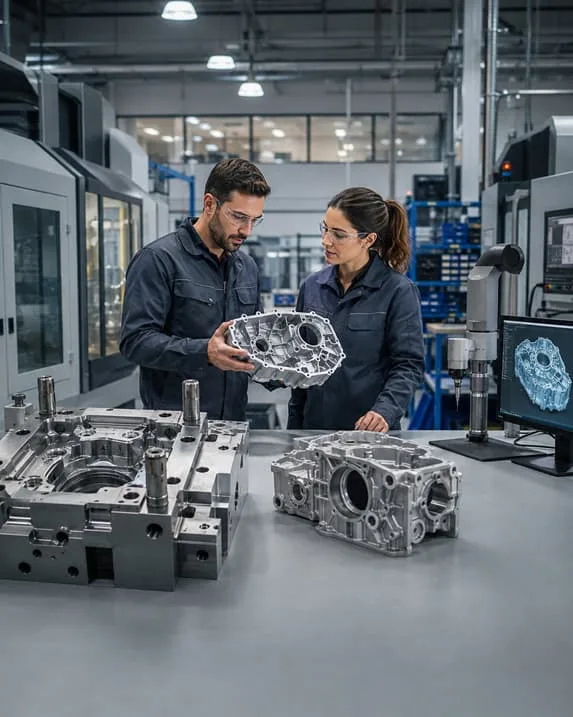
We chose not to split the process. We design the die, simulate its filling, manufacture the die in our own toolroom and cast the part on our own presses. Machining, surface treatment and assembly are links in the same chain.
What that means in practice: when a problem appears, there is no supplier in between. We can tell within the same day whether it came from the die, the alloy or a process parameter, and make the correction under the same roof. It is not the length of the chain that matters but how many hands it passes through.
We always begin a job with feasibility: geometry, parting line, draft angles and wall thickness distribution are reviewed for castability. Where needed we propose a small design change — moving a rib is far cheaper than picking porosity out later.
Every step from die design to assembly is in house; the delivery chain shortens and responsibility is not divided.
Injection parameters, alloy analysis and measurement results are recorded, so where a deviation began can be traced back.
Rather than casting an incoming model as it is, we propose improvements in casting logic.
WHY KILIÇASLAN?
Die, casting, machining, surface and assembly in one place. Responsibility in one pair of hands, turnaround short.
Filling and solidification are analysed before die steel is cut. We do not want surprises on the first trial shot.
An alloy is chosen not from the strength table alone but together with geometry and surface treatment expectations.
Cutting back on die steel and cooling design lowers the first invoice and raises the total cost.
COMPANY
Kılıçaslan is a manufacturer working in high pressure aluminium die casting and die design. One question sits at the centre of what we do: when a drawing reaches us, how do we produce that part with the least scrap and in a repeatable way?
Feasibility ReviewHOW WE WORK
The quality of a casting is decided at the drawing board, not at the press. An abrupt jump in wall thickness creates a hot spot; an unfed hot spot leaves a void, and no process setting closes that void completely. So we begin by reviewing the part.
Once the die design is approved, filling and solidification are simulated. Gate sections, vents and cooling layout are set from that analysis. The aim is to avoid surprises on the first trial shot — because adding steel to a die is far harder than removing it.
In series production we keep the variables on record. When injection speed, die temperature or intensification pressure drift within a batch, the shot where it began can be traced back. We aim to catch a deviation at the station where it appears rather than sort it out at the end.
We treat a die as a long term investment, not a consumable. Maintenance intervals, spare core strategy and thermal fatigue monitoring are therefore discussed from day one. A die that lasts quietly lowers the cost per part.
Kind regards, KILIÇASLAN ALUMINIUM
WHEN A JOB REACHES US
Every step below runs in house. The output of each station is recorded as the input of the next, so when a deviation appears there is no argument about where it came from.
We read the model for castability and propose revisions where needed. This step is free of charge.
Gating, venting and cooling decisions come from analysis — before any die steel is cut.
The die is machined in our own toolroom; trial shots and commissioning are ours as well.
Series production on a cold chamber press with process parameters under record.
Only critical surfaces are machined, so unnecessary fixturing cost does not reach the part.
Chromating, anodising or powder coating after deburring and blasting.
Measurement, plus leak and X-ray testing where required; results are reported with the part.
Time from sample approval to series production depends on part geometry and die complexity; we settle it together during the feasibility review.
Let Us Review Your PartOUR PRINCIPLES
These are not sentences for the wall; they are rules we actually apply when preparing a quote, choosing steel for a die and scrapping a part.
If we commit to a tolerance, we have a method that measures it and a record of it. We do not commit to what we cannot measure.
Injection parameters are on record, so the shot on which a deviation began can be traced back.
Cutting back on die steel and cooling design lowers the first invoice and raises the total cost.
Runners and casting scrap are recovered within our own cycle, which is why composition is checked continuously.
FEASIBILITY REVIEW
Share your technical drawing or 3D model and we will come back on castability, die approach and estimated lead time.