

Die design and simulation
Parting line, draft angles, wall thickness transitions and ejector layout are set; then gating, venting and cooling decisions follow from filling and solidification analysis.
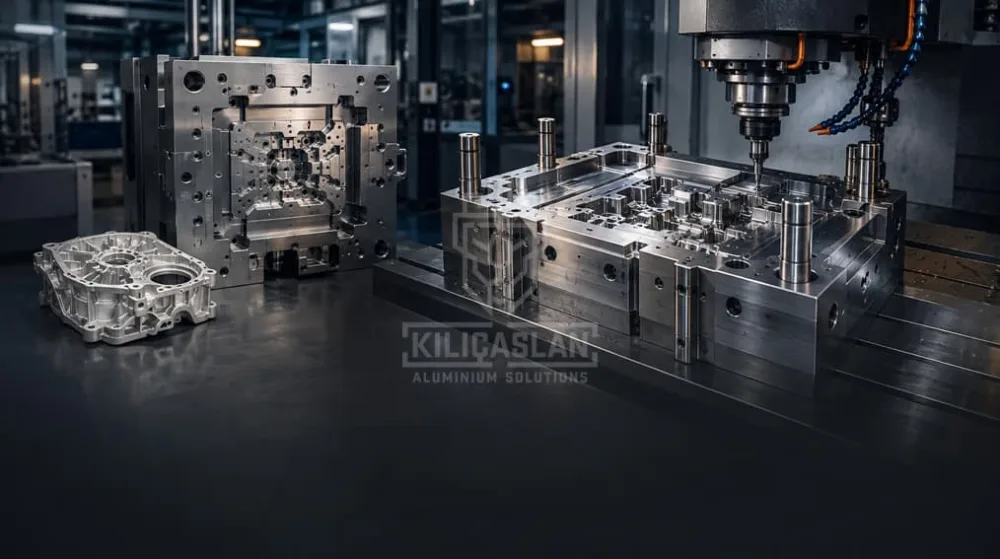
PRODUCTION LINEKılıçaslan Aluminium
Our production line is laid out to cover every step a part needs before and after casting. The headings below are not independent services; they are sequential links in the same chain.
The most tangible result is response time. Because the die stays with us, a revision decision does not move the part to another workshop; and because fixture design is ours too, a dimensional deviation from machining is assessed together with its cause on the die side.
One rule runs along the line: the output of each station is recorded as the input of the next. Injection parameters, measurement results and the surface treatment batch all hang off the same work order — when a deviation appears, where it began is not a matter of debate.
Maintenance, revision and spare cores are in our own toolroom; with the die never elsewhere, response time is short.
We design the dedicated clamping setup, so dimensional errors caused by fixturing are prevented at source.
Alloy analysis, injection records and measurement results can be traced back per batch.
LINE INFRASTRUCTURE
The right machine family for aluminium: metal is dosed into the sleeve every shot, and the injection system never sits in molten metal.
Die steel machining, assembly, trial shots and commissioning are never outsourced.
The CNC clamping setup is designed for the part, so no datum is lost on the second set-up.
Dimensional measurement, alloy analysis and, where needed, leak testing sit inside the flow rather than at the end of it.
CAPABILITIES
Of the six capabilities needed to produce a part, all six are in house. That does not mean we never buy in services; it means none of the critical decisions is taken outside our control.
Our ServicesWHAT WE CAN DO
Each heading produces the input of the next, which is why we do not price them independently but plan them as a single chain.
Parting line, draft angles, wall thickness transitions and ejector layout are set; then gating, venting and cooling decisions follow from filling and solidification analysis.
Die steel machining, assembly, trial shots and commissioning are in our own toolroom. While the die is in service, maintenance, revision and spares stay with us too.
Series casting on cold chamber presses with process parameters on record. Thin walled geometries, integrated cooling fins and cored internal channels are produced on this line.
Mating faces, holes and threads are machined on dedicated fixtures. Only critical surfaces are cut, so unnecessary fixturing cost does not reach the part.
Chromating, anodising or powder coating after deburring and blasting. The surface decision is taken together with alloy and tolerance, never bolted on later.
On request, bearings, bushes, helicoils and seals are fitted; the part ships as a ready assembly together with its measurement report.
HOW THE LINE RUNS
The seven stations below all hang off the same work order. Next to each step we have written the record it produces — because what describes a production line is not an equipment list but which decision is made against which evidence.
The model is read for castability. Record: revision proposals and the parting line decision.
Filling and solidification analysis. Record: gate section, venting and cooling layout.
Die steel machined, assembled and commissioned with a trial shot. Record: trial report.
Series production on a cold chamber press. Record: injection speed, die temperature, intensification pressure.
Machining on a dedicated fixture. Record: first article check of the critical dimensions.
Deburring, blasting and coating. Record: batch number and the approved finish sample.
Dimensional measurement, plus leak and X-ray testing where required. Record: measurement report, shipped with the part.
Machine list, tonnage ranges and capacity figures are deliberately not stated on this page; they will be added from the panel once verified.
Let Us Review Your PartFEASIBILITY REVIEW
Share your technical drawing or 3D model and we will come back on castability, die approach and estimated lead time.