
Deburring & Surface Preparation
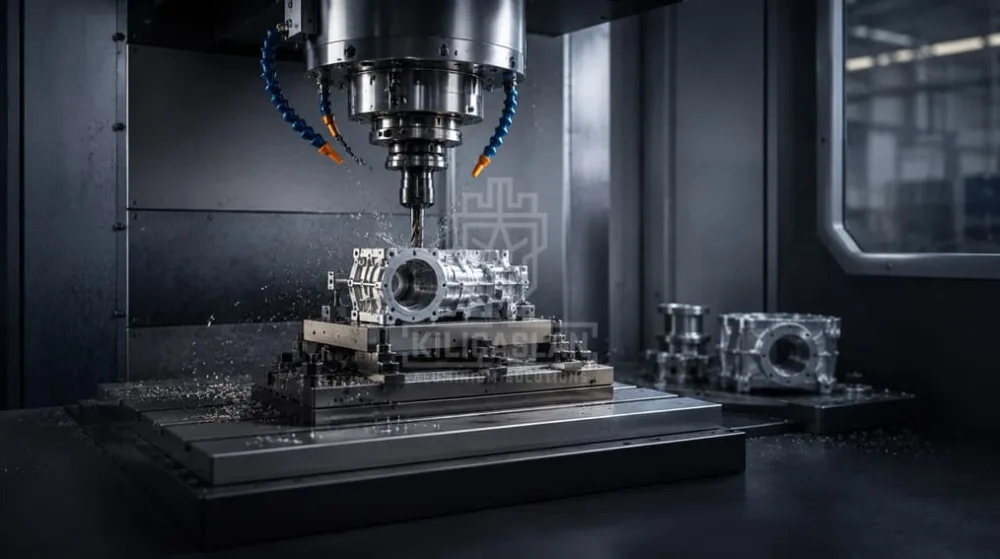
Deburring & Surface Preparation
Trim die, automatic deburring and shot blasting to prepare surfaces before coating.
Deburring and surface preparation is the stage where a casting moves from the state it leaves the press in to a state ready for assembly or coating. At Kılıçaslan this is not a visual tidy-up but a defined chain of operations: runners and overflows are removed, parting line flash is taken off, edges are broken and the surface is prepared for coating.
How flash forms on a casting
In high pressure die casting the melt penetrates the parting plane and the core clearances, if only by microns. Once solidified, that thin film remains on the edge of the part as flash. Runners, overflows and vent metal also come out attached to the part and have to be cut off.
Flash is not only a cosmetic issue. It disturbs mating faces during assembly, causes adhesion failures in coating, cuts hands in handling and leaves a sharp edge on the finished product.
The methods we use
Trim dies
In series production the most efficient route is a part-specific trim die: runner, overflow and parting flash are removed in a single press stroke. We build trim dies in our own tool room — see Die Manufacturing. A single stroke is both faster and more repeatable than hand work.
Vibratory finishing
For small and medium parts, edges are broken and the surface is evened out in vibratory bowls filled with abrasive media. Because it is a batch process, unit cost falls as volume rises.
Shot blasting
Abrasive blasting removes oxide and release agent residue and gives the part an even matt texture. It is also the most common mechanical preparation before powder coating and plating: a clean, textured surface is what determines adhesion.
Targeted manual deburring
Hole entries, deep channels and core transitions that automated methods cannot reach are deburred selectively. On critical parts this step is run against a checklist.
What "ready for coating" means
- No perceptible flash on the parting line or core transitions
- Hole entries chamfered and sharp edges broken
- No oil, release agent residue or dust on the surface
- A texture that is consistent across the batch, with no patches of gloss
A coating applied without these four conditions comes back as blistering and adhesion failure. Surface preparation is properly considered part of the coating itself.
Which method suits which part?
| Method | Suited to | Limit |
|---|---|---|
| Trim die | Series production, repeated geometry | Needs a part-specific tool |
| Vibratory finishing | Small and medium parts, batch work | Does not reach tight internal corners |
| Shot blasting | Preparation before coating, even texture | Precision faces must be masked |
| Manual spot deburring | Deep channels and hole entries | Cost rises with volume |
In practice these are not alternatives but a sequence: the trim die does the coarse separation, vibratory finishing breaks the edges, blasting evens the surface and the few remaining points are cleaned by hand. Which part follows which sequence is written into the control plan rather than left to the operator on the day.
Why Kılıçaslan
- The trim die is ours. Deburring is planned together with the die, so the flash line falls where it should from the start.
- A defined operation. Which part goes through which method is recorded, not left to the individual.
- The chain continues here. Whether the next step is machining or coating, the part stays in the same plant.
Frequently asked questions
Is deburring charged separately?
Standard deburring is included in the unit price of the casting. A specified edge radius, an additional blast texture or 100% visual inspection are quoted separately.
Does blasting change dimensions?
The dimensional effect is negligible, but the operation sequence takes it into account: tight-tolerance features are usually machined after blasting.
Do you offer deburring on its own?
We can deburr and blast parts cast elsewhere. We look at the part first and agree the method with you.
Tell us your surface requirement and we will put a preparation plan together.
Get information about this service
Our expert team is ready to offer you the best solution.