
Die Manufacturing
Die Manufacturing
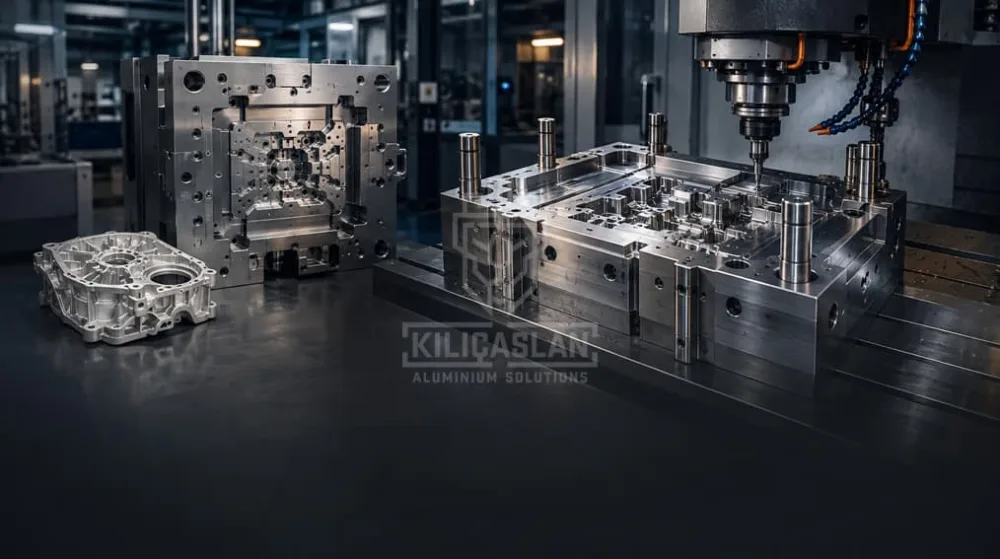
Every step from die steel machining to trial casting is carried out in-house.
Aluminium die manufacturing turns an approved design into a tool that runs on the press. Kılıçaslan does this in its own tool room: die steel machining, heat treatment, EDM, assembly and trial casting all happen under one roof. Because tooling and casting sit side by side, there is no supplier in between during commissioning.
The steps of die manufacturing
- Die steel selection. Hot work tool steels are chosen to withstand the thermal fatigue of aluminium. The balance of hardness and toughness determines how many cycles the die will survive.
- Rough machining. The die block and core pockets are brought close to size, leaving an allowance for distortion in heat treatment.
- Heat treatment. Hardening and tempering. This is the single step that most directly sets die life.
- Finish machining. Cavity, parting faces and core faces are brought to final size.
- EDM. Sharp corners, deep ribs and fine detail that a cutter cannot reach are produced by die-sink or wire EDM.
- Surface finishing and texture. Polishing or the specified texture is applied; this determines the visible surface of the casting.
- Assembly. Core movements, ejector system, cooling connections and seals are fitted.
- Trial casting (T0) and revision. The die is run, parts are measured, corrections are made and the trial is repeated.
What determines die life?
- Steel and heat treatment quality. An incorrectly tempered die cracks early; a properly treated one holds size across long runs.
- Thermal balance. Heat trapped in a hot region produces thermal fatigue cracking on the surface, which is why cooling channel placement is treated so carefully at design stage.
- Process discipline. Die temperature, release agent use and cycle regularity either wear the die out or protect it.
- Regular maintenance. Scheduled cleaning, ejector checks and timely replacement of wear items prevent unplanned stoppages.
Die maintenance and revision
A die is not finished when it is delivered. We take on maintenance through the life of the programme, replace wear items and revise the tool when the part changes. Dies built elsewhere can also be brought into our tool room for maintenance and revision.
What we build
- Die casting dies — the main tools for high pressure aluminium die casting
- Trim dies — runner and flash removed in a single press stroke; see Deburring & Surface Preparation
- Fixtures and gauges — part-specific work holding for machining and measurement
Our tooling product group is shown on the Tooling & Dies page.
Why Kılıçaslan
- Tool room next to the casting line. A finding from the trial shot can be back on the machine the same day.
- The design team follows the build. No information is lost between design and simulation and manufacturing.
- Delivered measured. Trial parts are measured on the CMM; approval rests on a report, not an impression.
- Tracked for life. Maintenance history and revisions are recorded.
Frequently asked questions
How long does a die take?
It depends on size, the number of core movements and the number of cavities. We give a realistic schedule after seeing the drawing rather than a number in advance.
Single cavity or multi cavity?
Annual volume and part size decide. A multi-cavity die yields more parts per cycle but needs a larger press and a more balanced filling design. We cost both options during feasibility.
Can you maintain my existing die?
Yes — dies built elsewhere are accepted for maintenance, revision and spare item manufacture.
How many parts come out of a trial?
Enough for measurement and, where required, destructive examination. Results are reported through quality control.
Get in touch and we will define the tooling concept with you.
Get information about this service
Our expert team is ready to offer you the best solution.