
CNC Machining
CNC Machining
Post-casting machining, hole and thread operations, and surfaces requiring defined finish.
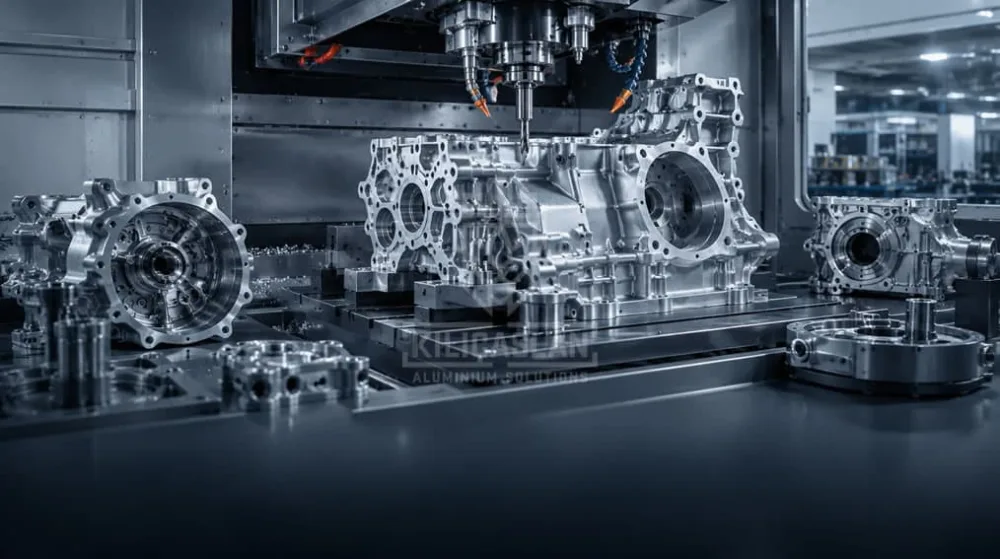
CNC machining brings the faces, bores and threads that cannot be held as-cast to their final size on machining centres. Kılıçaslan runs these operations in house and delivers the casting machined, measured and ready to use. There is no transport leg and no second supplier between casting and machining.
Why castings still need machining
High pressure die casting holds many dimensions in tolerance directly, but not all of them. Sealing faces, bearing and bushing seats, threaded connections, tight centre distances and flatness-critical mounting faces are normally machined. Machining is what reaches the micron-level tolerances and surface finish that casting alone cannot deliver.
General dimensional and geometric tolerances in the industry are defined by ISO 2768 and ISO 286; industrial practice in aluminium machining typically works in the ±0.05 to ±0.02 mm band. Which tolerance your drawing assigns to which feature determines both the machining plan and the measurement method.
Operations we perform
- Milling: mounting faces, seal grooves, pockets and slots
- Drilling and reaming: holes with tight positional tolerance, bearing seats
- Threading: tapped or thread-milled holes, including preparation for helicoil inserts
- Turning: face and diameter work on rotationally symmetric bodies
- Chamfering and edge preparation ahead of assembly
Part-specific fixtures
A casting is not as easy to clamp as a prismatic block: its faces are drafted and its datums are limited. We design a fixture for each part and build it in our own tool room. The right fixture is the quiet factor that keeps dimensions from drifting between parts.
Datums and operation sequence
The machining plan starts with which cast datum is taken as reference. A poorly chosen datum produces features that are each correct on their own but shifted relative to one another. We build the datum chain from the geometric tolerances on the drawing.
Machining aluminium: what matters
- High cutting speed: aluminium machines far faster than steel, which shortens cycle time.
- Chip control: sticky chips can form a built-up edge, so tool geometry and coolant are selected accordingly.
- Thermal expansion: aluminium heats and expands while being cut, so tight dimensions are measured once the part is thermally stable.
- Surface finish: with correct tooling and feed, surfaces need no additional polishing.
What happens after machining
Machined parts go to the measurement station: critical dimensions are verified on the CMM and a leak test is applied where required — see Quality Control & Metrology. The part then moves to surface treatment or assembly.
Why Kılıçaslan
- Casting and machining at one address. The part does not shuttle between plants.
- Our own fixtures. The team that builds the die also builds the work holding.
- Closed feedback loop. A recurring deviation in machining goes back to the casting parameters or the die.
- Subcontract machining too. We machine aluminium parts cast elsewhere.
See Manufacturing & Capabilities for our machine park.
Frequently asked questions
Can I send parts for machining only?
Yes. We take on subcontract machining of parts cast elsewhere, with the limits of measurement responsibility agreed in writing up front.
What tolerances can you hold?
Achievable tolerance depends on part size, wall thickness, clamping face and feature position. We review the critical dimensions on your drawing and state in writing which will be held by machining and which by casting.
Who decides the machining allowance?
The allowance is planned during die design. Too little and the face does not clean up; too much and you pay for chips and cycle time.
Do you machine small batches?
Yes, including sample and prototype batches, which are usually part of the prototyping process.
Send us your drawing and we will return an operation plan and a price.
Get information about this service
Our expert team is ready to offer you the best solution.