
Reverse Engineering & Prototyping
Reverse Engineering & Prototyping
3D scanning of an existing part, model creation and pre-series sample production.
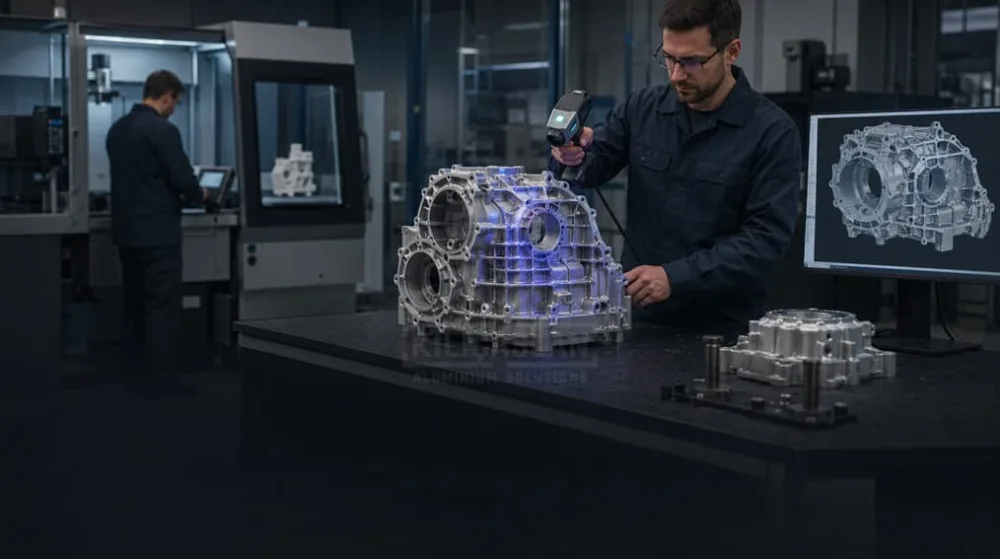
Reverse engineering takes a part you have no drawing for and makes it manufacturable again. Kılıçaslan digitises the existing part by 3D scanning, verifies its dimensions, builds a CAD model suited to casting and produces a pre-series sample. It is usually the shortest route to restarting a line that has stopped for want of a part.
When reverse engineering is needed
- No drawing exists. The part was made years ago and the documentation is gone.
- The supplier is changing. The original maker no longer exists, or you do not hold the die.
- A spare part is required. The machine still runs but the part is off the market.
- The part is being improved. Existing geometry is taken as the basis for a strength or weight revision.
- The process is changing. A sand cast or machined part is moving to high pressure die casting.
How the process runs
- Part assessment. Wear, deformation and previous repairs are identified, and it is decided what counts as the original dimension.
- 3D scanning. Optical or laser scanning captures the surface as a point cloud, recording complex free-form surfaces completely.
- Model creation. The point cloud becomes an editable solid model. This is a rebuild, not a copy: cylinders are built as cylinders, planes as planes.
- Dimensional verification. Critical dimensions are measured separately on the CMM and compared with the model — see Quality Control & Metrology.
- Adaptation for casting. Draft angles, wall thickness transitions, parting line and machining allowances are added. Without this the model is not castable.
- Sample production. A part is produced for approval and measured.
Why a scanned model cannot be cast directly
A scan gives the part as it is today: worn, possibly deformed, perhaps repaired. It also lacks the draft angles and machining allowances casting requires. The model is therefore rebuilt with engineering decisions — see why draft angle matters in die design.
Prototypes and pre-series samples
Seeing the geometry physically before committing to tooling saves time on most projects. Depending on part size, quantity and the properties to be verified, a sample can be machined from solid or produced from simple tooling. Where final material properties have to be confirmed, the sample must be cast — a choice we make together.
After approval the project returns to the standard route: die design and filling simulation, then die manufacturing and series casting.
Why Kılıçaslan
- The model is built with casting in mind. The team that scans also designs the die.
- Measurement backed. The model is verified against CMM data, not judgement.
- The whole chain in house. From scan to series, one address and one responsibility.
- Intellectual property discipline. We work on parts that are yours or free to produce; we do not copy a protected third-party design.
Frequently asked questions
I only have a broken part — is that enough?
Usually yes. Missing regions can be reconstructed from symmetry, the mating part and assembly information. If the missing area is critical we ask to see the mating part as well.
Does scanning damage the part?
No. Optical and laser scanning are non-contact methods and the part is returned to you unchanged.
Can you copy another company's product?
No. We do not assist in copying products protected by patent, utility model or registered design. Your own products, spare parts with no remaining supplier and designs out of protection fall outside that.
How soon do I get a sample?
It depends on complexity and the sample method chosen. We give a firm schedule after seeing the part.
Send us the part or a photograph of it and we will assess whether reverse engineering suits it.
Get information about this service
Our expert team is ready to offer you the best solution.