
High Pressure Aluminium Die Casting
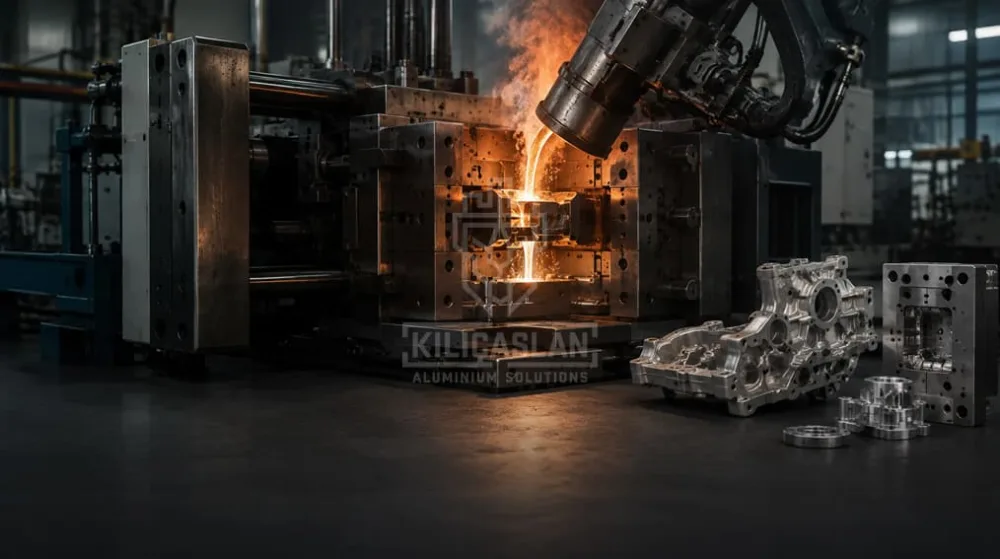
High Pressure Aluminium Die Casting
Series production of thin walled, dimensionally stable parts on cold chamber presses.
High pressure aluminium die casting forces molten aluminium into a steel die cavity on a cold chamber press and holds it under pressure while it solidifies. At its plant in Adana, Türkiye, Kılıçaslan uses this process to produce thin walled, dimensionally stable aluminium castings in series. Because we design and build the die ourselves, the part stays with a single supplier from drawing to shipment.
What is high pressure die casting?
The process is known internationally as HPDC. Aluminium alloy is melted in a furnace, a measured shot is transferred to the injection sleeve, and a piston pushes it into the die. Pressure is maintained until the metal has fully solidified, so shrinkage voids close before they can grow and the internal structure stays dense.
Die casting is the right answer when the same part has to be produced thousands or hundreds of thousands of times. Unlike sand casting the die is permanent: a correctly designed and properly maintained steel die holds the same dimensions across long runs. Repeatability is what this process actually sells.
Cold chamber versus hot chamber
The melting point of aluminium does not allow the injection unit to sit permanently in molten metal, so aluminium is cast on cold chamber presses: each cycle a measured shot is ladled into the sleeve from a separate furnace. The hot chamber system common in zinc alloys is not suitable for aluminium. Our injection line is cold chamber.
Advantages of high pressure die casting
- Thin walls: wall sections in the typical 1.5–3 mm range fill completely, so the same strength is achieved with less metal.
- Dimensional stability: the steel die does not drift between cycles; many dimensions stay in tolerance as-cast.
- Short cycle time: a cycle takes seconds rather than minutes, which is what drives the unit cost down in series production.
- Complex geometry: cooling fins, ribs, mounting lugs and bearing seats are cast in one piece.
- Surface finish: the as-cast surface is often ready for coating without intermediate grinding.
- Material efficiency: runners, overflows and flash return to our own melting cycle.
How our casting process works
- Feasibility review. Geometry, parting line, draft angles and wall thickness transitions are assessed for castability — see our note on why draft angle matters.
- Die design and filling simulation. Runner, cooling and venting are designed and verified before any steel is cut: Die Design & Filling Simulation.
- Die manufacturing. Every step runs in our own tool room: Die Manufacturing.
- Sample casting and approval. First trial parts are measured and the die is revised where needed. No series run starts without approval.
- Series production. Shot weight, phase velocities, die temperature and holding pressure are recorded, so a deviation can be traced back to the cycle where it started.
- Finishing and delivery. After deburring, machining, surface treatment and assembly the part ships ready to use.
Alloy selection and porosity
The most common alloys for high pressure aluminium die casting come from the silicon-rich Al-Si family; standard grades such as EN AC-46000 and EN AC-47100 are favoured for their fluidity and resistance to hot tearing. The right choice depends on mechanical load, service temperature, leak-tightness requirements and the surface treatment that follows — we set out the criteria in how to choose an aluminium casting alloy.
The classic weakness of the process is gas porosity. For parts that will be welded or must hold pressure, that risk is reduced at the design stage through venting, gate cross-section and phase velocities. See reducing porosity in die castings.
What we cast
- Automotive die castings — housings, covers, brackets and carriers
- Electrical and electronic enclosures — heat dissipating, sealed boxes
- Lighting luminaire bodies — finned LED housings
- Home appliance parts
- Machinery and industrial parts
Why Kılıçaslan
- Die and casting under one roof. When a deviation comes from the die, there is no third party in between.
- Simulation-verified design. Fewer trials and a shorter run-up to first good part.
- Measured quality. CMM report, alloy analysis and leak test results ship with the part — see Quality Control & Metrology.
- Machined delivery. Machining, surface treatment and assembly in one shipment.
Our production capability is described on the Manufacturing & Capabilities page.
Frequently asked questions
At what volume does die casting make sense?
The die is a one-off investment, so the process gets more attractive as volume rises. For a few hundred pieces the tooling dominates the unit price; for runs in the thousands casting usually beats the alternatives. We work the figure out with you during the feasibility review.
Does a casting still need machining?
Many dimensions come out in tolerance as-cast, but sealing faces, bearing bores and threaded holes are normally machined. We do that in house — see CNC Machining.
Who owns the die?
The die belongs to the customer who pays for it. We store it, maintain it and use it for your orders, and hand it over on request.
How long does it take to move from sample to series?
It depends on part complexity and die size, which is why we only commit to a date after seeing the drawing.
Send your drawing through our contact page and we will assess castability and quote.
Get information about this service
Our expert team is ready to offer you the best solution.